The Existential Dread of Being a Dog
We can make a perhaps surprising Sartrean contribution to this problem, which is especially interesting due to its links with Lacan; this time, instead of Lacan following Sartre, the situation is more the reverse. I am referring to a relatively unknown passage from The Family Idiot. It concerns the life of a pet dog.
“Pure ennui de vivre” is a pearl of culture. It seems clear that household animals are bored; they are homunculae, the dismal reflections of their masters. Culture has penetrated them, destroying nature in them without replacing it. Language is their major frustration: they have a crude understanding of its function but cannot use it; it is enough for them to be the objects of speech – they are spoken to, they are spoken about, they know it. This manifest verbal power which is denied to them cuts through them, settles within them as the limit of their powers, it is a disturbing privation which they forget in solitude and which deprecates their very natures when they are with men. I have seen fear and rage grow in a dog. We were talking about him, he knew it instantly because our faces were turned toward him as he lay dozing on the carpet and because the sounds struck him with full force as if we were addressing him. Nevertheless we were speaking to each other. He felt it; our words seemed to designate him as our interlocutor and yet reached him blocked. He did not quite understand either the act itself or this exchange of speech, which concerned him far more than the usual hum of our voices – that lively and meaningless noise with which men surround themselves – and far less than an order given by his master or a call supported by a look or gesture. Or rather – for the intelligence of these humanized beasts is always beyond itself, lost in the imbroglio of its presence and its impossibilities – he was bewildered at not understanding what he understood. He began by waking up, bounding toward us, but stopped short, then whined with an uncoordinated agitation and finished by barking angrily. This dog passed from discomfort to rage, feeling at his expense the strange reciprocal mystification which is the relationship between man and animal. (Sartre, The Family Idiot, vol. 1, trans. Carol Cosman, p. 137-138)
As Lacan would say, Sartre’s dog is the object of the discourse of the Other, caught inside of yet excluded from the symbolic order. And it is as if the beast were frozen there, stuck in that object-position, unable to do anything but growl and whimper. While the human has a mastery of language that the dog can never possess, it too bears within itself the echo of this same existential malaise. There is no fully cultural being, no human that is not a “humanized beast”: the gap between nature and culture is never completely bridged, the human remains a creature of this unstable transition, always in a process of becoming. And to connect this idea of a gap with our previous discussion: in Lacanian terms, Sartre’s pet dog is confronted by the Thing, a zone of confusion and disorientation which is covered neither by nature (the compass of pleasure and unpleasure) nor by culture (institutional laws and norms). The dog is caught in the empty transition or caesura between instincts and institutions, and it is this gap that is the cause of the “reciprocal mystification” between humans and animals – a mystification that the human animal has internalized, and which constitutes its blurry and unstable difference.
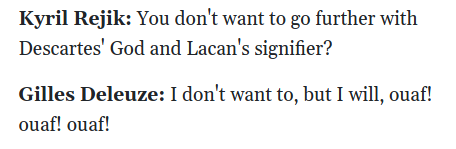
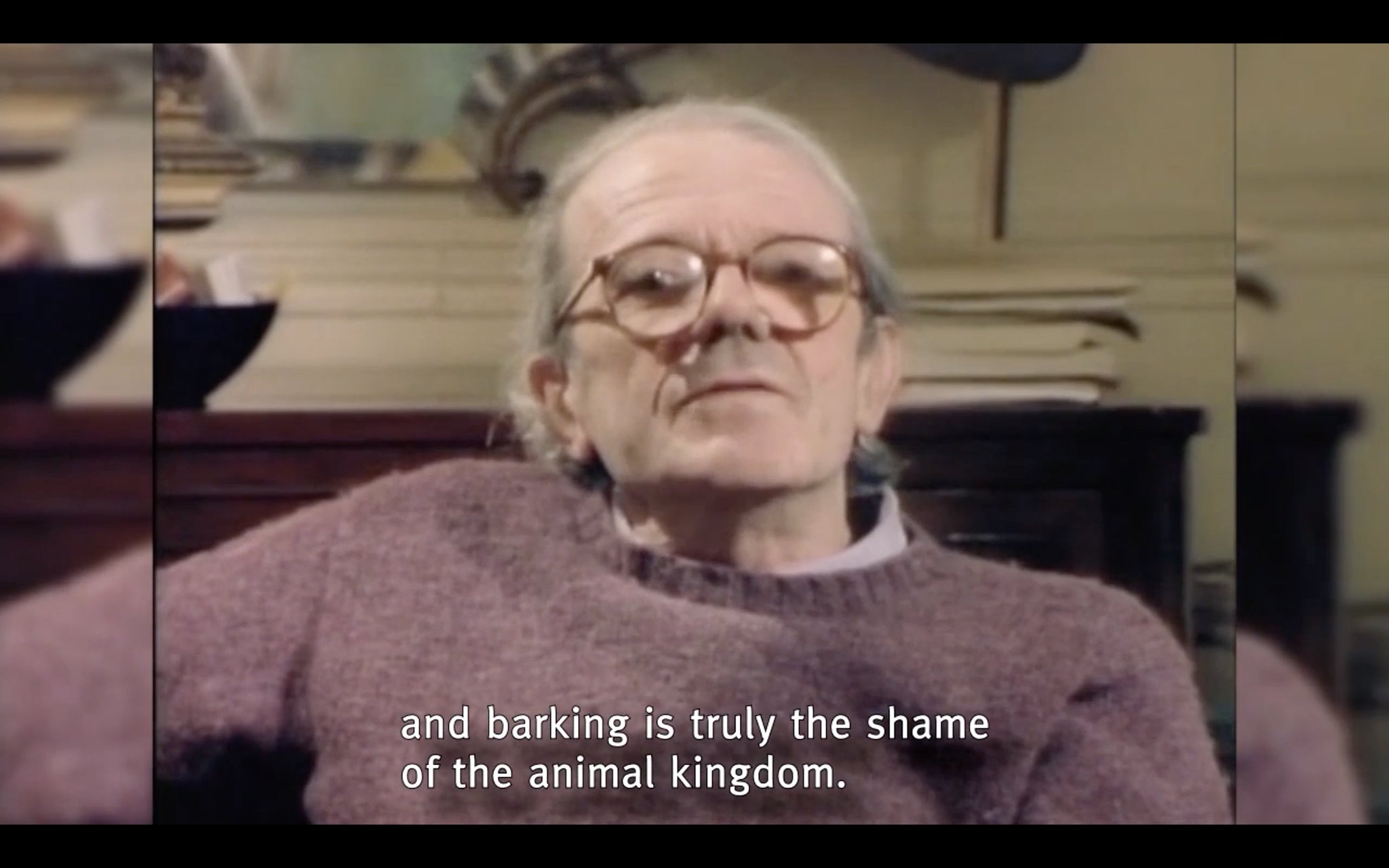
[…] For Deleuze, the dog’s bow-wow is the stupidest cry of the animal kingdom. But maybe its dumb cries are not simply those of training and obedience, but express a more uncanny becoming that got stuck halfway. “Thus childhood is no longer an age but an animal category: there are monkeys, there are dogs, there are children. Perhaps, if carefully inspected, the child is merely a dog who is unaware of itself.” (Sartre, The Family Idiot, vol. 1, 346.)
Schuster, Aaron. 2016. The Trouble with Pleasure: Deleuze and Psychoanalysis. Short Circuits. Cambridge, Massachusetts: The MIT Press. 148 ff.